Modern Standard Arabic vs Spoken Arabic: Which Should You Learn First?
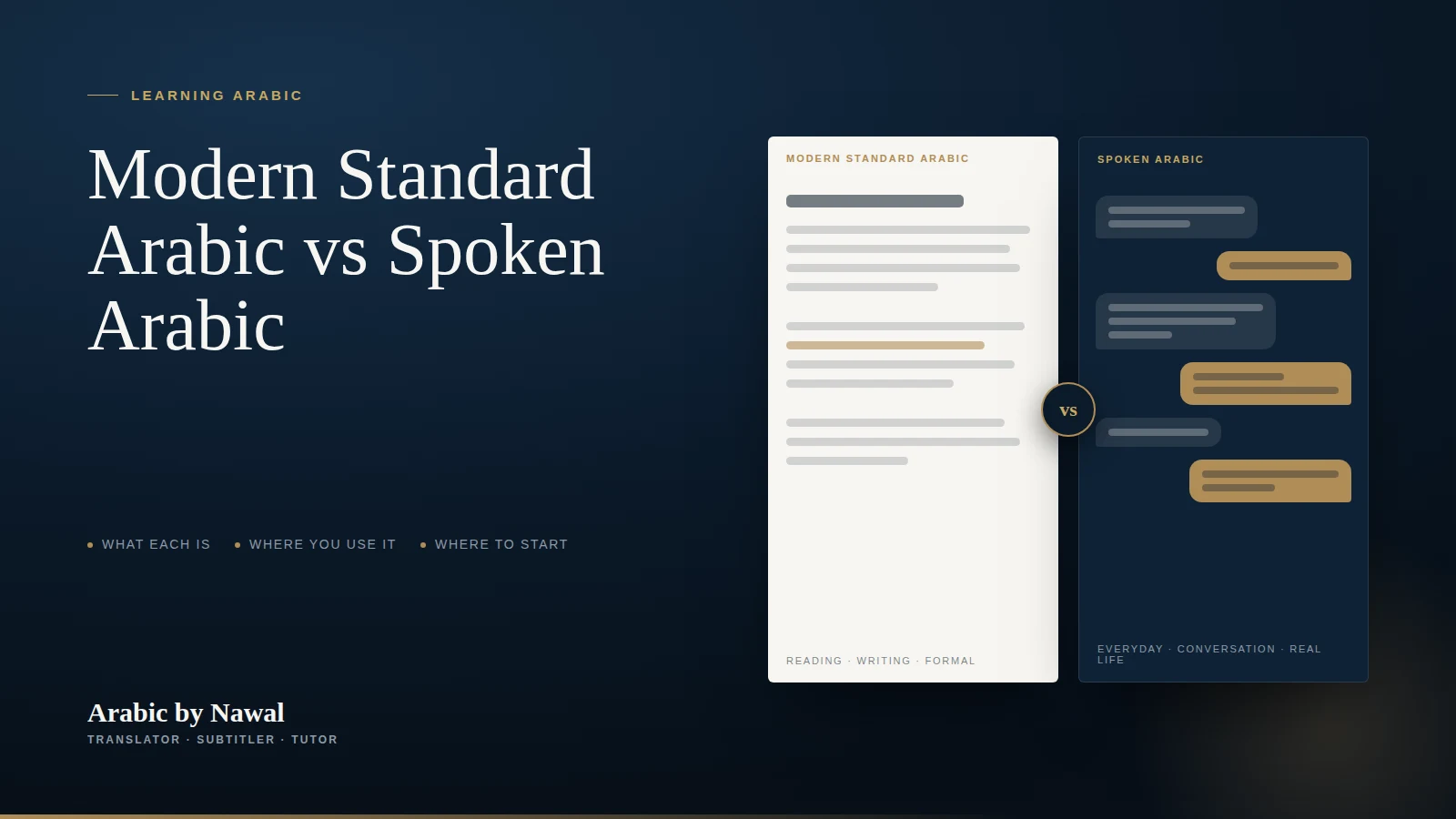
Modern Standard Arabic vs spoken Arabic is the first real decision every learner faces, usually before they’ve had a single lesson. Get it right and Arabic feels practical from the start. Get it wrong and you can spend a year studying without ever having a conversation. This guide explains what each one is, where you’ll actually use it, and how I help students choose in their first lesson.
The short version
Arabic is one written language and many spoken varieties.
- Modern Standard Arabic (MSA) is the shared, formal form. It’s what you read in newspapers and books, hear in news broadcasts and speeches, and see in official documents and signage across every Arab country.
- Spoken Arabic is what people use in daily life: at home, at work, in shops, with friends. It varies by region, and it’s the Arabic you’ll hear the moment you talk to someone.
If you want to talk to people, start with spoken Arabic. If you need to read, write or work in formal settings, start with MSA. Many learners eventually do both.
What is Modern Standard Arabic?
Modern Standard Arabic is the modern form of Classical Arabic, standardised so that Arabic speakers from Morocco to Oman share one written language. It has fuller grammar than spoken Arabic and a formal vocabulary.
You’ll meet MSA in:
- News channels, newspapers and magazines
- Books, academic writing and formal reports
- Government forms, laws and official speeches
- Public signage and announcements
- Religious texts and study
Nobody speaks MSA at home. That’s not a criticism; it’s simply not what it’s for. It’s the language of reading, writing and formal communication, and for some learners that’s exactly what they need. See my Modern Standard Arabic lessons for how I teach it.
What is spoken Arabic?
Spoken Arabic is the everyday language, and it comes in regional varieties. Linguists group them into broad families (the varieties of Arabic article gives a clear overview), but for a learner the practical point is simpler: spoken Arabic has lighter grammar, everyday vocabulary, and the rhythm of real conversation.
In the Modern Standard Arabic vs spoken Arabic question, two things make spoken Arabic the natural starting point for most people:
- It’s what you’ll hear. Colleagues, neighbours, shopkeepers, family: all spoken Arabic.
- It’s faster to use. Simple phrases, introductions and everyday exchanges come quickly, which keeps motivation high.
If you don’t have a specific dialect in mind, I use a practical form of spoken Arabic that is widely understood and choose the approach based on your goals. If you have a specific country in mind, because of family, work or where you live, we focus on that. The Arabic dialects page explains how that choice works.
Modern Standard Arabic vs spoken Arabic: side by side
| Modern Standard Arabic | Spoken Arabic | |
|---|---|---|
| Used for | Reading, writing, formal speech | Everyday conversation |
| Spoken at home | No | Yes |
| Grammar | Fuller, more formal | Lighter, more flexible |
| Vocabulary | Formal, shared across the Arab world | Everyday, varies by region |
| First results | Reading and comprehension | Speaking and understanding people |
| Best first step if you want to | Read, write, work formally | Talk to people |
Which one should you learn first?
Ask yourself what you want Arabic for. The answer usually decides it.
Start with spoken Arabic if you want to:
- Talk with colleagues, friends, neighbours or a partner’s family
- Feel comfortable in daily situations: shops, transport, appointments
- Understand what’s being said around you
- Build confidence quickly
Start with Modern Standard Arabic if you want to:
- Read Arabic news, documents, reports or books
- Work in media, government, law, education or diplomacy
- Study Arabic formally or take an exam
- Read religious or classical texts
Do both if:
- You’re staying long-term in an Arabic-speaking environment
- You’ve already studied some MSA and want to finally speak
- Your work needs both formal Arabic and daily conversation
In my experience, most learners are best served by spoken Arabic first, with MSA added when their goals call for it. That’s the order I recommend in my conversational Arabic lessons, but I plan every student’s path individually.
Do you need to read and write to start?
No. If your main goal is to speak, we can start without focusing on reading and writing. I can use Arabizi (Arabic written with Latin letters and numbers) when it’s useful, especially at the beginning, so you can understand and practise more easily. Reading and writing can be introduced later if you want them; for MSA-focused learners they come in from the start, because that’s what MSA is for.
Can you learn one and then the other?
Yes, and it’s easier than people expect. MSA and spoken Arabic share the same roots, most core vocabulary, and the same underlying logic. Once you know one, the other is far closer than starting from zero. Think of it as moving between registers of one language, not learning two unrelated ones.
How I decide with each student
In the free trial lesson we talk about three things: what you want Arabic for, where you’ll use it, and how you like to learn. From that, I recommend a starting point and a plan. Some students leave the trial with a spoken-Arabic plan; some with MSA; some with a combination. There’s no default, because there’s no single right answer to Modern Standard Arabic vs spoken Arabic, only the right answer for you.
If you want the wider picture first, read How to Learn Arabic: A Beginner’s Guide.
Frequently asked questions
Should I learn Modern Standard Arabic or a dialect? If you want to speak with people day to day, start with a practical form of spoken Arabic. If you need to read, write or work with formal Arabic, start with MSA. Many learners combine both.
Which dialect do you teach? I try to make Arabic as simple and practical as possible. If you don’t have a specific dialect in mind, we use a practical form of Arabic that is widely understood and choose the best approach based on your goals. If you have a specific dialect or country in mind, we can focus on that.
Is Modern Standard Arabic useful for conversation? People will understand you, but it sounds formal in everyday situations. It’s the right choice for reading, writing and formal contexts, and a good complement to spoken Arabic.
Can I switch later? Yes. Many students start with spoken Arabic and add MSA later for work or reading, or the other way round. The two support each other.
Can I learn from another country? Absolutely. All lessons are one-to-one and online, scheduled around your time zone, so you can learn Arabic from wherever you are.
More answers on the FAQ page.
Not sure which is right for you?
That’s what the free trial is for. Tell me what you want Arabic for, try a short lesson, and I’ll recommend where to start. No previous knowledge and no commitment needed.

Arabic Language Professional | Translator, Subtitler & Tutor. Master's in Translation (USJ), media localization for Asharq News, and online Arabic tutor to 30+ students worldwide.
Ready to start?
Choose the path that fits you. Both begin with a short conversation.