
How to Learn Arabic: A Beginner’s Guide
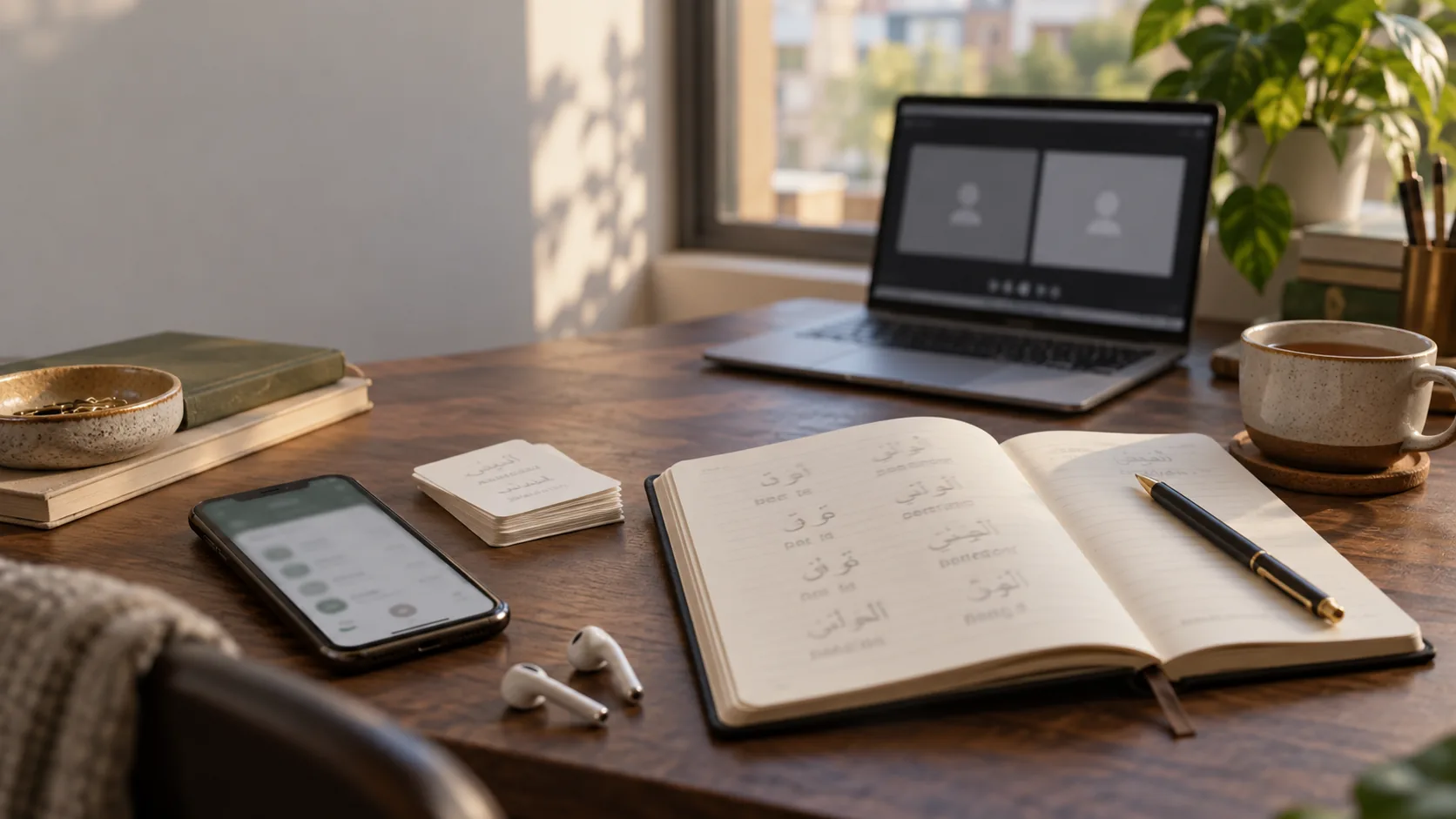
Every week, people search for the same things: how to learn Arabic, is Arabic hard to learn, how long does it take to learn Arabic, what’s the best way to learn Arabic. I’ve taught Arabic online to more than thirty learners in different countries, and almost all of them started with one of those questions. This guide answers them in one place, without the myths, and ends with a plan you can start this week.
Is Arabic hard to learn?
It doesn’t have to be. Arabic has a reputation for difficulty that comes mostly from how it’s usually taught, not from the language itself. Traditional courses start with formal grammar and classical texts, and learners spend months studying without ever having a conversation. That’s discouraging, and it’s why so many people say “I tried Arabic once.”
When you start with simple phrases, introductions and everyday conversation, and build from there at your own pace, progress comes quickly. You don’t need to read or write to start speaking. In my lessons I can use Arabizi (Arabic written with Latin letters and numbers) when it helps at the beginning, so you can understand and practise more easily. The demanding parts come later, if and when you want them.
What actually makes Arabic feel manageable:
- A native speaker who explains things simply, in your language when needed
- Speaking from the first lesson, not after a term of theory
- Learning the Arabic people actually use, not only the formal written form
- Material built around your life and your reasons for learning
That’s the approach behind my conversational Arabic lessons.
How long does it take to learn Arabic?
There’s no honest single number, because “learn Arabic” means different things to different people. It depends on your goals, your starting point, and how much you practise outside lessons.
A more useful way to think about it is in stages:
- First conversations. Greetings, introducing yourself, simple questions and answers. Most beginners reach this within their first weeks of consistent lessons.
- Everyday communication. Shopping, transport, small talk, understanding what’s said around you. This is the goal for most learners, and it’s very reachable with regular practice over a few months.
- Work and professional Arabic. Meetings, clients, the vocabulary of your field. It builds on the stage above; see Arabic for everyday life and work.
- Reading, writing and formal Arabic. Only if your goals need it: news, documents, formal correspondence.
The learners who progress fastest aren’t the ones with the most hours; they’re the ones who practise a little, often, and focus on what they actually need instead of trying to learn everything at once.
Which Arabic should you learn?
This is the question that trips up most beginners, so here’s the short version.
Arabic is one written language and many spoken varieties. Modern Standard Arabic (MSA) is the shared form used in news, books, official documents and formal speech across every Arab country. Spoken Arabic is what people use in daily life, and it varies by region. Arabic is one of the six official languages of the United Nations and is spoken by more than 400 million people, according to the UN’s Arabic Language Day page, which is part of why the spoken varieties differ so much from place to place.
So which one is right for you?
- You want to talk to people: start with spoken, practical Arabic.
- You need to read documents, follow the news or work in a formal setting: start with Modern Standard Arabic.
- You want both: many learners do, and a good plan combines them.
If you don’t have a specific dialect in mind, the practical choice is a widely understood form of spoken Arabic that works across the region. If you have a specific country in mind, because of family, work or where you live, focus on that. I explain how I choose the approach with each student on the Arabic dialects page.
What’s the best way to learn Arabic?
There are many ways to study Arabic, and the best one depends on your goals and your schedule. Here’s how the main options compare, in my experience as a tutor and as someone who works with Arabic professionally every day.
Language apps. Good for vocabulary drills and daily habit. Weak for conversation, pronunciation feedback and understanding real speech. Use them as a supplement, not a plan.
Group classes. Affordable and social, but the pace is set for the group and speaking time per student is limited. Most group courses also default to formal Arabic, even when students want to speak.
Self-study with books and videos. Works for disciplined learners who mainly want to read. Hard to sustain alone, and there’s nobody to correct you.
One-to-one online lessons with a native tutor. The fastest route to actually speaking, because every minute is yours: your questions, your mistakes corrected, your topics. Online means you can learn from anywhere in the world, in your own time zone, without a commute. That’s what I offer through private online Arabic lessons.
The most effective combination for most beginners: one-to-one lessons for structure and speaking practice, plus a few minutes of daily exposure (audio, a series, an app) between sessions.
Can I learn Arabic online?
Yes, and for many learners it’s the best option. Online lessons give you a native tutor regardless of where you live, flexible scheduling around your time zone, and the same one-to-one attention as an in-person lesson. Screen sharing makes notes, audio and materials easy to share and keep. My students are based in different countries around the world, and online is how they all learn.
How to learn Arabic fast, without burning out
“Fast” is possible if you define it well. You won’t be fluent in a month, but you can be holding real conversations sooner than you think. What speeds things up:
- Decide what you want Arabic for. Work, family, travel, living in an Arabic-speaking country: your goal decides what you learn first.
- Speak from day one. Even badly. Especially badly. Confidence comes from using the language, not from waiting until it’s perfect.
- Learn phrases, not just words. “Where is…?”, “Can I have…?”, “I’d like to…” carry you further than long vocabulary lists.
- Listen daily. Arabic music, a series, a podcast, even in the background. Your ear learns before your mouth does.
- Practise consistently. A little every day beats a lot once a week. Choose a frequency that fits your life and keep it.
- Get feedback. A native tutor catches the pronunciation and grammar habits an app never will.
Common mistakes beginners make
- Starting with formal Arabic when the goal is conversation
- Trying to learn every dialect at once instead of committing to one approach
- Waiting to “feel ready” before speaking
- Relying on an app alone and expecting to become conversational
- Giving up after a hard week instead of adjusting the plan
Almost every one of these is fixable with the right structure and a teacher who adapts to you.
A simple plan for your first month
Week 1: Greetings, introductions, numbers, basic questions. Your first short conversation. Week 2: Everyday situations: shops, transport, ordering, asking for help. Listening practice starts. Week 3: Talking about yourself: work, family, where you live, what you like. Longer exchanges. Week 4: Review, real conversation practice, and a plan for what comes next based on your goals.
This is roughly how I structure a beginner’s first weeks, adjusted to each person. By the end of it, most learners are surprised by how much they can already say.
Frequently asked questions
Is Arabic hard to learn for English speakers? It doesn’t have to be. Start with simple phrases and everyday conversation and build from there at your own pace. You don’t need to know the Arabic alphabet to start speaking, and Arabizi can make the beginning easier.
How long does it take to learn Arabic? It depends on your goals, your starting point and how much you practise outside lessons. Some learners focus mainly on speaking and everyday communication; others also want reading, writing or professional Arabic. Focus on what you actually need and build from there.
Should I learn Modern Standard Arabic or a dialect? If you want to speak with people day to day, start with a practical form of spoken Arabic. If you need to read, write or work with formal Arabic, start with MSA. Many learners combine both.
Can I learn Arabic without learning the alphabet? Yes. If your main goal is to speak, you can start without reading and writing, using Arabizi when useful, and add the script later only if you want to.
How often should I take lessons? There’s no one-size-fits-all schedule. Choose a frequency that fits your goals, availability and pace. What matters most is consistency and enough practice to keep building on what you learn.
Can I learn Arabic online from any country? Absolutely. All my lessons are one-to-one and online, scheduled around your time zone, so you can learn Arabic from wherever you are.
More answers on the FAQ page.
Ready to start?
The fastest way to know whether Arabic is for you is to try it. Book a free trial lesson: we’ll talk about what you want Arabic for, try a short lesson, and plan where to begin. No previous knowledge and no commitment needed.

Arabic Language Professional | Translator, Subtitler & Tutor. Master's in Translation (USJ), media localization for Asharq News, and online Arabic tutor to 30+ students worldwide.
Ready to start?
Choose the path that fits you. Both begin with a short conversation.